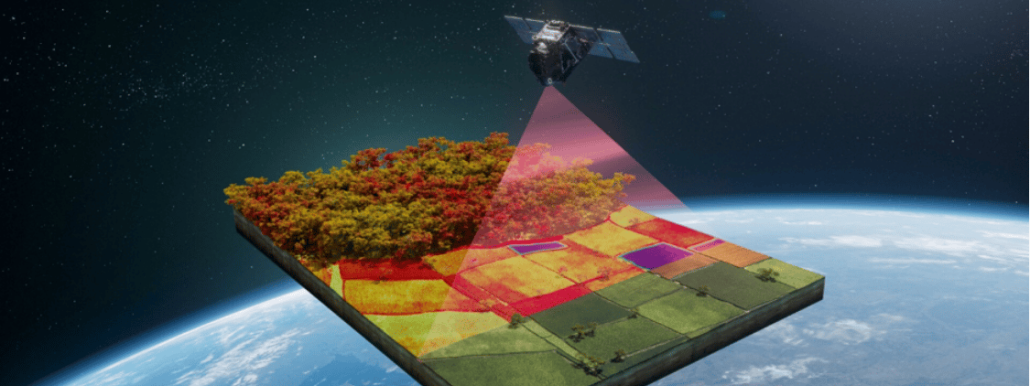
 Credit ESA/ATG medialab
FLEX and Sentinel-3C: watching plants breathe and tracking a changing planet
Today, two satellites lifted off together from Europe’s Spaceport in French Guiana. One is there to watch plants breathe. The other will continue monitoring key environmental and climate variables, building on observations collected by its predecessors since 2016.
They will help us better understand the health of vegetation and the wider conditions shaping our changing planet.
Two satellites, one launch
The two satellites are FLEX, a new ESA Earth Explorer mission, and Copernicus Sentinel-3C, the third satellite in Europe’s Sentinel-3 series. They travelled into space aboard the same Vega-C rocket, using a specially designed configuration that allowed them to be released separately.
FLEX: watching plants breathe
FLEX carries FLORIS – the Fluorescence Imaging Spectrometer – an instrument designed to detect something the human eye cannot see: the faint glow emitted by plants as they photosynthesise.
This signal changes according to a plant’s health and growing conditions. It can reveal early signs of stress caused by drought, heat or disease, sometimes before they become visible in a field.
On its own, however, this signal tells only part of the story. To interpret it correctly, scientists also need information about factors such as land-surface temperature, vegetation type, clouds and atmosphere. These are among the variables already measured by Sentinel-3.
Now in space, FLEX will fly in tandem with Sentinel-3A satellite already in orbit, and later on with Sentinel-3C. Together, their measurements are expected to give scientists a far more complete picture of how vegetation is functioning across the planet.
Sentinel-3C: continuing the watch
Copernicus Sentinel-3C, jointly managed by ESA and EUMETSAT, is the third satellite in a series that has been operating since 2016. Its role is not simply to introduce new observations, but to help ensure that an essential monitoring service continues without interruption.
Its instruments support a wide range of applications. They measure sea-surface temperature, ocean colour, wave height, wind and changes across land and ice. These observations may contribute to weather and ocean forecasts, safer navigation, the early detection of harmful algal blooms, and the monitoring of active fires, just to mention a few.
Why long-term observations matter for our changing planet
Across Europe, the effects of a changing planet are becoming increasingly visible through extreme heat, wildfires, prolonged droughts and rising sea levels. The ocean plays a central role in these changes, absorbing roughly 90% of human-driven heat, shielding us from either grater impacts of global warming.
This process is already reshaping currents, ecosystems and weather patterns.
At the same time, around 30 million people in Europe live in coastal flood plains exposed to sea levels rise.
Changes of this scale cannot be understood from a single snapshot. They require the same measurements, collected consistently over many years. This is why keeping the Sentinel-3 series operating without interruption matters.
A single observation can tell us what is happening today. A long, continuous record can help a coastal community, fishing fleet or planning authority understand whether a particular year was unusual or whether it signals a lasting shift.
And through the Copernicus programme, much of this data is made freely available, often within hours of being collected, so that researchers, public authorities, businesses and other organisations can turn observations from space into practical information.
This article is part of EOReach, a Progressive Systems initiative created to bring Earth Observation data, tools and knowledge into a wider range of application domains.
Through our EarthConsole® platform, we help researchers, public authorities, businesses turn data and analytical models into operational digital services for environmental and climate monitoring. If you would like to explore how Earth Observation data could support your work, contact us at info@earthconsole.eu.
Image credit: ESA/ATG medialab