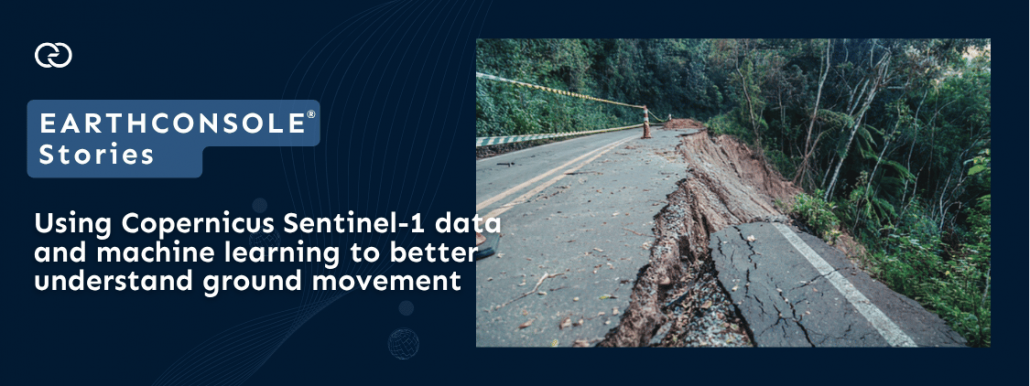
EarthConsole® Stories: using Copernicus Sentinel-1 data and machine learning to better understand ground movement
EarthConsole® Stories are experiences about how we helped universities, research centres or service developers to leverage Earth Observation data to extract valuable insights for their research, educational or pre-commercial projects.
The Project
Understanding how and why the ground moves is essential for managing natural resources, infrastructure, and environmental risks. This research project, developed at Politecnico di Torino, focuses on improving the detection and interpretation of ground deformation through innovative data analysis methods.
To achieve this, the study uses machine learning techniques to analyse large amounts of data over time, with the objective of automatically identifying patterns and grouping together areas that behave in a similar way.
A key goal is to better understand what drives ground deformation behaviour, with a specific focus on human-induced activities such as water extraction.
By studying these factors across a range of environments, the project seeks to build a completer and more reliable picture of how and why deformation occurs.
This work is part of the first Italian National PhD programme on Sustainable Materials, Processes, and Systems for Energy Transition, established under the National Recovery and Resilience Plan.
The Need
The project required reliable satellite data to monitor subtle ground movements over time. Access to Sentinel-1 C-band radar imagery was essential, as it provides consistent observations regardless of weather or lighting conditions, making it ideal for continuous monitoring.
Another key requirement was the use of DInSAR techniques, which compare satellite images taken at different times to measure how the ground has moved, making it possible to produce consistent and comparable time series to be used as input for the project processing chain.
Why EarthConsole®
EarthConsole® was selected because it provides access to the P-SBAS on-demand service for Sentinel-1, which implements a DInSAR technique developed by CNR-IREA. This service enables efficient processing of Sentinel-1 C-band data, offering the possibility to compute displacement time series and the corresponding mean deformation velocity map with centimeter to sub-centimeter accuracy.
Reflecting on the experience, the project coordinator shares:
The ability to process Sentinel-1 data on demand, without relying on local infrastructure, has enabled us to focus on interpreting results rather than managing complex workflows. The platform allows us to easily generate deformation time series over our areas and periods of interest, aligned with the availability of ancillary data. Its fast processing capabilities and user-friendly interface have been essential for efficiently exploring a range of study cases.
Alberto Manuel Garcia Navarro, PhD Student, Politecnico di Torino – Italy
The Impact
This project contributes to advancing how ground movement is monitored and understood, with important benefits for both science and society. By making it easier to detect and interpret deformation patterns, it supports more informed decision-making in areas such as infrastructure management, environmental protection, and energy systems..
This project has been supported via the ESA Network of Resources initiative.